Friday, 21 February 2014

Thought for the week Second Sunday Before Lent

My exercise teacher constantly reminds us to breathe and be present. He says, "For the next hour, you are here, on this mat." It takes more concentration than I possess to quiet my mind. It's easy for me to dwell in the past or project into the future, meanwhile missing my life which is going on right now. Jesus tells us not to be anxious. He commands us not to be afraid more times in Scripture than any other mandate, so he obviously knows our penchant for worry. Worry is a coping mechanism for a control freak, a misguided notion that if we give something enough energy, we can affect the outcome. Not so. Our worry is indicative of a lack of trust. The only solution is to remember that perfect love casts out fear. Stop worrying and trust. Be present and allow God to move on your behalf.
Kristin Armstrong

Thursday, 30 January 2014

Thought for the Week Presentation of Christ in the Temple

Waiting for fulfillment of a promise,
Waiting to see the longed-for light,
Waiting in devotion of a lifetime,
Simeon, trusting God to keep his word.
Ready for the prompting of the Spirit,
Ready for the revelation joy
Mixed with cross-shaped shadows of
the future,
Simeon, holding Mary’s God-filled boy.
Daphne Kitching

Friday, 24 January 2014

Thought for the Week The Conversion of St Paul

Light broke in suddenly,
shattering my pride,
expanding my mind
and splintering into shards
my heart.
'Why kick and wound
like a frightened child?
Release yourself to me;
know me, honour me;
I am Jesus, I am God's Word.'
Then I was led,
where once I led;
blindness caused my fall.
My eyes were opened to Light
and the gift of life!
JCH

Friday, 17 January 2014

Thought for the Week 3rd Week of Epiphany

The Word of God
It teaches,Encourages,
Holds out hope
And shines light
When days are dark
And the way unclear.
It guides,
Speaks life and power
Today,
As it has,
As it will
Forever.
God’s word,
Spoken,
Written,
Pointing always
To the one who
Was in the beginning,
Co- author, co-creator,
Walking word,
Living word,
Jesus,
Word.
Daphne Kitching

Tuesday, 31 December 2013

The Donkey's return

Paul returned from University and so did the Donkey.
He made his first return in the advent crib. Many saw the crib in church but not the three wise donkeys making there way across the church.
The crib was just 24hrs old when it was displayed

 Paul was very kind to Jenny at the Donkeys second appearance at the Nativity service. Paul thoughtfully put out a copy of the Nativity sheet on the pulpit for Jenny.
This was not quite the same as the copies held by the rest of the congregation. All the music was changed to Jenny's favourite Little Donkey with a few little known versions of other traditional carols such as Silent Donkey Holy Donkey.
There were many such changes to Jenny's sheet. Fortunately Jenny spotted Pauls name on the sheet in time.

The Donkey made his last appearance on  Christmas day in the Sermon slot starring as himself in the form this time of a glove puppet in the crossing.
We we very proud to see that one of the other little girls in the sermon slot came dressed as a Donkey. Such is the effect of the Donkey.

Thought for the week First week of Christmas

Lovely in your littleness,
longing for our lowliness,
searching for our meekness…..
Held in Mary's tenderness,
tiny hands are raised to bless,
touching us with God's caress.
Joy then in God's graciousness,
peace comes with gentleness,
filling hearts with gladness.
Margaret Rizza

Tuesday, 24 December 2013

Thought for the Week Christmas Eve

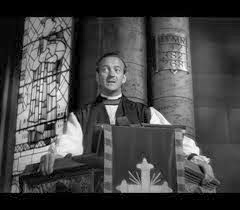
At this time of the year I am often reminded of the words from the sermon given at the end of that wonderful 1940’s Hollywood movie called The Bishop’s Wife. 
Dudley, who is played by Cary Grant is an Angel who has been assigned to Bishop Henry Brougham, played by David Niven. His task is to assist Henry by answering his prayer for help. Amongst the many things that he does, including using a wonderful word processor is that Dudley re-writes the Bishop’s Christmas Eve sermon. 
“Tonight I want to tell you the story of an empty stocking. Once upon a midnight clear, there was a child's cry. A blazing star hung over a stable and wise men came with birthday gifts. We haven't forgotten that night down the centuries; we celebrate it with stars on Christmas trees, the sound of bells and with gifts. But especially with gifts. You give me a book; I give you a tie. Aunt Martha has always wanted an orange squeezer, and Uncle Henry could do with a new pipe. We forget nobody, adult or child. All the stockings are filled -- all that is, except one. And we have even forgotten to hang it up. The stocking for the child born in a manger. It's his birthday we are celebrating. Don't ever let us forget that. Let us ask ourselves what he would wish for most, and then let each put in his share. Loving kindness, warm hearts and the stretched out hand of tolerance. All the shining gifts that make peace on earth.”
A Happy Christmas to one and all.

Thursday, 19 December 2013

Thought for the Week Fourth Sunday of Advent


Once again, we welcome you bending so low to creep among us, not forcing, not shouting, too gentle to even flicker our candle flames. Make your home among us again, we pray; be our guest, in heart and home and city, in the empty, howling wastelands of our times, and light up your world once again with the new hope and the new life that faith in you still brings.
John Harvey,
from Going Home Another Way.

Thought for the week Third Sunday of Advent

Maybe
Maybe it is in the waiting for God,
not in the wandering from store to store,
that we find our way.
Maybe it is in the friendship of God,
not in the frenzy of the crowds,
that we are led to the manger.
Maybe it is in the steadfast love of God,
and not in the pile of stuff under the tree,
that we find what we have been
searching for all our lives.
Maybe, just maybe, God of Advent,
this year will be different.
Maybe, just maybe,
we will let you lead us to Bethlehem.
Thom Shuman

Friday, 6 December 2013

Thought for the week Second Sunday in Advent


God help us to hear your voice
through the babble of this world
where words are used to confuse,
distract, manipulate, sell illusion,
buy power;
help us to be still and receptive
to your healing,
encouraging,
inspiring,
enduring,
life giving
Word…..
Neil Paynter

Thursday, 28 November 2013

Thought for the week Advent Sunday

Bright Star-Maker God,
travel with us
through Advent,
shine into our
dark corners,
lead us into
ways of justice,
warm us
with joy and wonder,
bring us
to new birth.
Ruth Burgess

John 8:12; 12; 35-36

Jesus said, “I am the world’s Light.
No one who follows me stumbles around in the darkness.
I provide plenty of light to live in.”

“ For a brief time still, the light is among you.

Walk by the light you have, so darkness does not destroy you. If you walk in darkness, you don’t know where you’re going.

As you have the light, believe in the light. Then the light will be within you and shining through your lives.


You’ll be children of light.”

Friday, 22 November 2013

Thought for the week Christ the King

Most references to Jesus as king occur during the Passion story. The symbol of Christ’s kingship is not a crown but a cross. The Son of God became human and died a horrible death on the cross to release his subjects from captivity. The One who is the true king of our world made this ultimate sacrifice out of his deep and abiding love for the world, a world constantly in rebellion against him. Christ’s kingship is not like a king with a jewel-encrusted crown in purple finery on a gold throne wielding an oppressive rod of iron. Rather, he is the crucified God with a crown of thorns hanging half naked on a cross of shame to set us free from our bondage. Jesus’ comes to us not as a great conquering military leader who oppresses and abuses the conquered. Rather, he comes as the Prince of Peace, the One whose reign proclaims peace, justice, liberation, and above all, service. Jesus turns the whole concept of lordship and kingship on its head.

Thursday, 7 November 2013

Thought for the Week Remembrance Sunday

The Parable Of The Old Man and The Young

So Abram rose, and clave the wood, and went,
And took the fire with him, and a knife.
And as they sojourned both of them together,
Isaac the first-born spake and said, My Father,
Behold the preparations, fire and iron,
But where the lamb for this burnt-offering?
Then Abram bound the youth
with belts and straps,
And builded parapets and trenches there,
And stretchèd forth the knife to slay his son.
When lo! an Angel called him out of heaven,
Saying, Lay not thy hand upon the lad,
Neither do anything to him, thy son.
Behold! Caught in a thicket by its horns,
A Ram. Offer the Ram of Pride instead.
But the old man would not so, but slew his son,
And half the seed of Europe, one by one.
Wilfred Owen

They shall grow not old, as we that are left grow old: 
Age shall not weary them, nor the years condemn. 
At the going down of the sun and in the morning 
We will remember them.

Friday, 1 November 2013

Thought for the Week All Saints

The forms and individual characters of living and growing things, of inanimate beings, of animals and flowers and all nature, constitute their holiness in the sight of God. Their inscape is their sanctity. It is the imprint of his wisdom and his reality in them. But what about you? What about me? Unlike the animals and the trees, it is not enough to be what our nature intends. It is not enough for us to be individuals. For us, holiness is more than humanity. If we are never anything but people, we will not be saints and we will not be able to offer to God the worship of our imitation, which is sanctity. For me to be a saint means to be myself. Therefore the problem of sanctity and salvation is in fact the problem of finding out who I am and discovering my true self. Trees and animals have no problem. With us it is different. God leaves us free to be whatever we like. Our vocation is not simply to be, but to work together with God in the creation of our own life, our own identity, our own destiny.
Excerpts adapted from New Contemplation by Thomas Merton

Thursday, 24 October 2013

Thought for the Week Bible Study 27th Oct 2013

The Bible is not the word of God. It may contain the word of God, in the way that a womb may contain a baby. But the womb is not the baby. Scripture may become the word of God under the inspiration of the Spirit, and often does. But it is heretical and idolatrous to imagine that the word of the living God can be objectified in such a way that it exists within and is limited by a set of printed words on a page. The word of God cannot be separated from the relational presence of God. The word of God is the self-communication of God, and therefore is dynamically connected to the person of God. One cannot know the word of God without knowing God.
Michael Riddell The threshold of the future (SPCK, 1998)

Luke   (4.16-24)
When Jesus came to Nazareth, where he had been brought up, he went to the synagogue on the sabbath day, as was his custom.  He stood up to read, and the scroll of the prophet Isaiah was given to him.  He unrolled the scroll and found the place where it was written:  ‘The Spirit of the Lord is upon me, because he has anointed me to bring good news to the poor.  He has sent me to proclaim release to the captives and recovery of sight to the blind, to let the oppressed go free, to proclaim the year of the Lord’s favour.’
And he rolled up the scroll, gave it back to the attendant, and sat down.
The eyes of all in the synagogue were fixed on him. Then he began to say to them, ‘Today this scripture has been fulfilled in your hearing.’ All spoke well of him and were amazed at the gracious words that came from his mouth.  They said, ‘Is not this Joseph’s son?’
He said to them, ‘Doubtless you will quote to me this proverb, “Doctor, cure yourself!” And you will say, “Do here also in your home town the things that we have heard you did at Capernaum.”’  And he said, ‘Truly I tell you, no prophet is accepted in the prophet’s home town.’

Friday, 11 October 2013

Thought for the Week Twentieth Sunday after Trinity


Loving God,
out of our homelessness
we turn to you;
out of our helplessness
we come to you;
out of our hunger,
out of our pain
we return to you.
In love,
deep love
we come.
Stand beside us,
comfort our helplessness,
feed our hunger,
tend out pain,
hear our cry
and welcome us home.
Kate McIIlhagga

Sunday, 6 October 2013

Thought for the week Harvest Festival

For farmers and for fishermen
Lord, bless the holy seed
Outshine the fresh fruit from your plot
Unearth the good things you have got
Rejoice in heart and deed
Love’s labour lasts however long
And will show signs but heed
Toil for the foods that fail to rot
Eat of the bread from heaven’s plot
Rejoice in souls you feed
ARH

John.            (6: 25-35)
When they found Jesus on the other side of the sea, the crowd said to him, ‘Rabbi, when did you come here?’ Jesus answered them, ‘Very truly, I tell you, you are looking for me, not because you saw signs, but because you ate your fill of the loaves. Do not work for the food that perishes, but for the food that endures for eternal life, which the Son of Man will give you. For it is on him that God the Father has set his seal.’
Then they said to Jesus, ‘What must we do to perform the works of God?’ Jesus answered them, ‘This is the work of God, that you believe in him whom he has sent.’ So they said to him, ‘What sign are you going to give us then, so that we may see it and believe you? What work are you performing? Our ancestors ate the manna in the wilderness; as it is written, “He gave them bread from heaven to eat.”’
Then Jesus said to them, ‘Very truly, I tell you, it was not Moses who gave you the bread from heaven, but it is my Father who gives you the true bread from heaven. For the bread of God is that which comes down from heaven and gives life to the world.’  They said to him, ‘Sir, give us this bread always.’ Jesus said to them, ‘I am the bread of life. Whoever comes to me will never be hungry, and whoever believes in me will never be thirsty.’

Friday, 27 September 2013

Thought for the Week 29th September Michael and All Angels

Angels.

Angels in Bible stories.
Angels in and out of our lives.
Michael: defeater of dragons, destroyer of evil.
Raphael: matchmaker, healer, traveller.
Gabriel: messenger, teller of truth.
And another name, Lucifer,
the brilliant one, who fell from the heavens,
the son of the morning,
the star of the dawn.
Angels.
Angels whose names are not known to us:
making Sarah laugh, and Jacob limp,
and Balaam tremble;
letting Peter out of prison,
advising Paul.
Questioning angels and challenging angels,
guardian angels who cradle little ones,
angels who see travellers safely home
and safeguard stumbling feet.
Angels.
Angels all around us.
God’s confidantes,
God’s messengers.
Angels
full of truth
and full of glory,
bright with joy.
Ruth Burgess

Sunday, 22 September 2013

Thought for the week Seventeenth Sunday After Trinity

At the Hermit's Cell
A prayer used on pilgrimage at the site of the Hermit's Cell on Iona.
Now, O Lord, calm me into a quietness
that heals and listens,
that moulds my longings and passions,
my wounds and wonderings
into a more holy, human shape.
In the silence let me listen
and hear the truth you have put in me;
trust the love you have for me
which you call me to live out
with all my sisters and brothers
in your human family.

Friday, 30 August 2013

Thought for the week Fourteenth Sunday After Trinity

A spirituality of politics means walking humbly with God. It is not closeted, albeit pious, immobility. It is a walk, a way of life guided by strategy, but sustained by faith, made possible by policy, but nurtured by prayer. It is a private and public acknowledgement of our utter dependence upon God, of our openness to be called upon by the authority of the poor. We are engaged in politics, not simply to ‘help’ others, but because we are compelled by justice. For us justice is not a philosophic concept or a legal definition or an ideologically adapted and approved slogan. It is, as the prophet Micah has taught us, the act of humbly walking with God.

Allan Boesak
from The Tenderness of Conscience

Luke         (14.1, 7–14)

On one occasion when Jesus was going to the house of a leader of the Pharisees to eat a meal on the sabbath, they were watching him closely. When he noticed how the guests chose the places of honour, he told them a parable.

‘When you are invited by someone to a wedding banquet, do not sit down at the place of honour, in case someone more distinguished than you has been invited by your host; and the host who invited both of you may come and say to you,
“Give this person your place,” and then in disgrace you would start to take the lowest place.

But when you are invited, go and sit down at the lowest place, so that when your host comes, he may say to you, “Friend, move up higher”; then you will be honoured in the presence of all who sit at the table with you.  For all who exalt themselves will be humbled, and those who humble themselves will be exalted.’


He said also to the one who had invited him, ‘When you give a luncheon or a dinner, do not invite your friends or your brothers or your relatives or rich neighbours, in case they may invite you in return, and you would be repaid. But when you give a banquet, invite the poor, the crippled, the lame, and the blind. And you will be blessed, because they cannot repay you, for you will be repaid at the resurrection of the righteous.’